

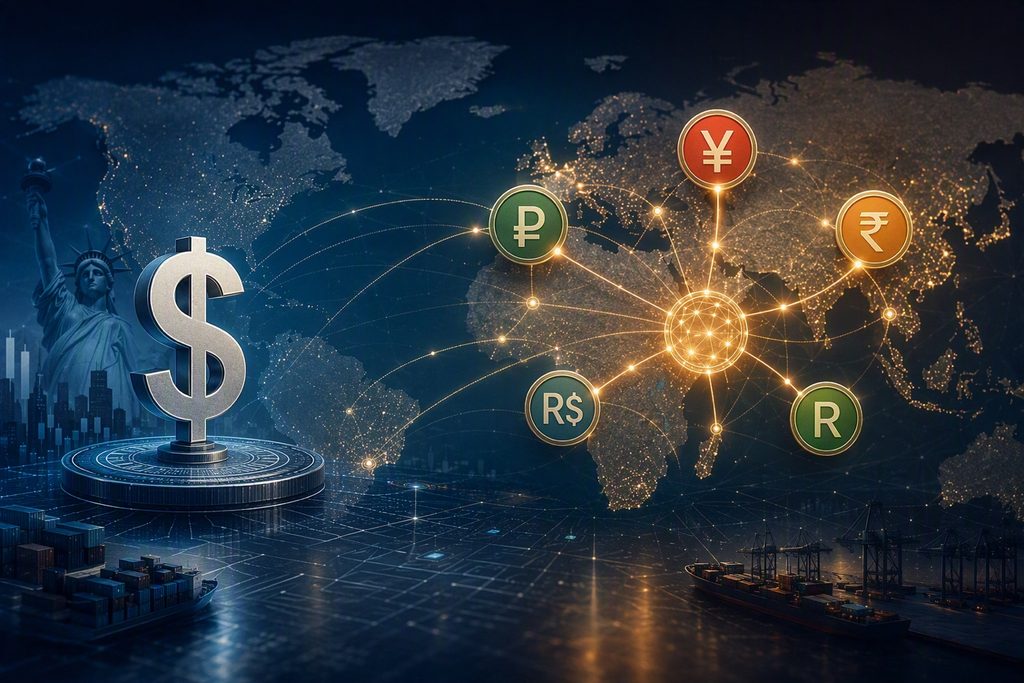
As BRICS expands its membership and influence, one of its most important ambitions is to reduce dependence on the U.S. dollar in global trade. The group is not yet creating a single common currency, but it is working toward practical alternatives: local-currency settlements, faster cross-border payments, and better links between national payment systems. These ideas have become more visible after the BRICS New Delhi 2026 Summit, where payment reform, financial sovereignty, and global economic balance were central themes.
The BRICS Push for Financial Alternatives
BRICS began as a platform for major emerging economies, but it has gradually developed into a wider voice for the Global South. Its members argue that the existing global financial system gives too much power to Western institutions and to the U.S. dollar. Because most international trade, commodity pricing, banking settlements, and reserve holdings still depend heavily on the dollar, countries outside the West often face pressure when dollar liquidity becomes tight or when geopolitical tensions affect financial access.
For this reason, BRICS countries are exploring ways to make international transactions cheaper, faster, and less vulnerable to external pressure. The main objective is not to destroy the dollar overnight, but to create additional channels through which member countries can trade with one another using their own currencies. This would reduce the need to use the dollar as the middle currency in every transaction.
Local-currency settlement is at the centre of this agenda. Instead of an Indian company and a Brazilian company routing payment through dollars, they could settle part of their trade in rupees and reais. Similar arrangements could involve the yuan, ruble, rand, dirham, or other currencies used by BRICS members. This approach may be especially useful in trade involving energy, minerals, food, manufactured goods, and infrastructure projects.
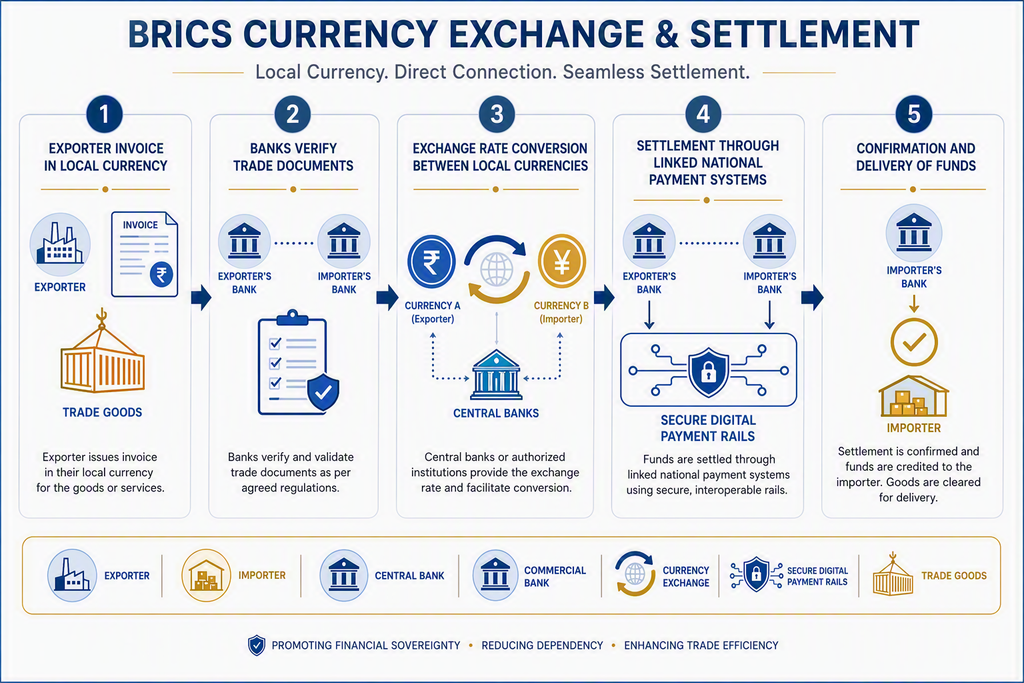
However, BRICS has not agreed to launch one common currency. A shared currency would require deep political trust, common monetary rules, coordinated fiscal policies, and strong economic convergence among member states. Because BRICS members have different economic systems, inflation rates, exchange-rate policies, and strategic priorities, the more realistic path is payment cooperation rather than a euro-style monetary union.
The New Delhi 2026 Summit gave this agenda new importance. The summit supported greater use of national currencies in trade and investment settlements, while also emphasizing that there is no single model that fits every member. This means countries can move at different speeds, depending on their banking systems, currency stability, and national priorities.
| Graphical Fact | Meaning for the Article |
| Local-currency settlement | BRICS wants more trade to be paid directly in national currencies rather than always through the dollar. |
| Payment-system interoperability | Member states are discussing ways to connect national payment networks for faster and cheaper transactions. |
| No common BRICS currency yet | The current focus is practical payment cooperation, not a single shared currency. |
| Dollar impact | The dollar may face gradual competition in selected trade corridors, but it remains dominant globally. |
New Delhi 2026: Key Discussion Points and Outcomes
One major discussion point at New Delhi was local-currency settlement. BRICS leaders backed the idea that member countries should be able to conduct more trade and investment using their own currencies. The outcome was a stronger political commitment to reducing transaction costs and limiting unnecessary dependence on the dollar, although the bloc did not announce a full break from the dollar-based system.
A second important outcome was the rejection of a common BRICS currency for now. Rather than creating one currency for all members, BRICS focused on practical cooperation through payment channels, settlement mechanisms, and financial connectivity. This shows that the bloc is taking a gradual route: first building trust and infrastructure, then expanding financial cooperation over time.
The summit also highlighted cross-border payment interoperability. This means improving the ability of national payment and messaging systems to communicate with one another. If successful, such systems could make transfers faster, cheaper, more transparent, and safer. Possible future examples include linking fast-payment networks and exploring central bank digital currency connections where countries are ready.
Another key message was financial sovereignty. BRICS presented payment reform as a way for countries to gain more control over their own trade and financial decisions. This is important for countries concerned about sanctions, currency volatility, or dependence on foreign-controlled clearing systems. The outcome was not a direct declaration of war against the dollar, but the creation of a parallel pathway that may reduce dollar dominance gradually.
The New Delhi Declaration also connected payment reform to a wider economic message. BRICS criticized unilateral sanctions, secondary sanctions, tariffs, and protectionist measures, arguing that such actions can distort trade and weaken the rules-based global economy. The broader outcome was that payment cooperation became part of a larger demand for a more balanced international financial order.
Why More Countries May Want to Join BRICS
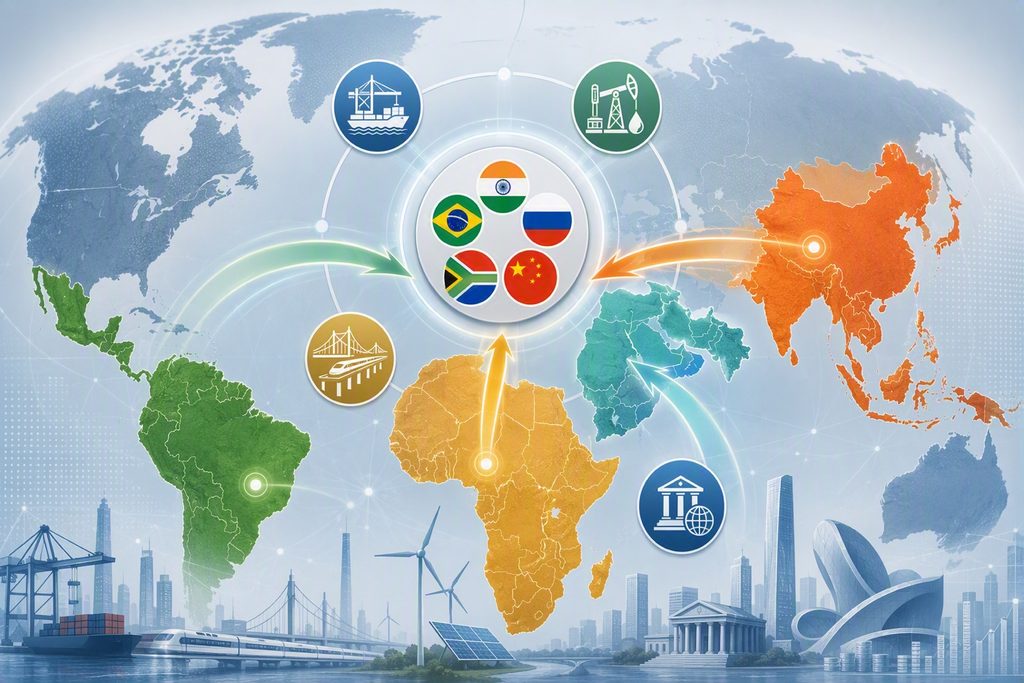
BRICS expansion is another reason the payment debate matters. Countries are interested in BRICS because it offers access to a larger economic network, stronger South-South cooperation, alternative development finance, and a platform to demand reforms in global institutions. For many emerging economies, BRICS is attractive because it allows them to balance their relations with both Western and non-Western powers.
In the coming years, more countries may become interested in joining BRICS because the group presents itself as a platform for emerging and developing economies that want greater influence in global affairs. For many countries in Asia, Africa, the Middle East, and Latin America, BRICS offers a way to strengthen trade links, attract investment, gain access to alternative development finance, and participate in discussions about reforming the global financial system.
Recent examples show why BRICS is becoming attractive. Egypt, Ethiopia, Iran, and the United Arab Emirates joined the bloc in 2024, while Indonesia became a full member in 2025. In addition, several countries such as Belarus, Bolivia, Cuba, Kazakhstan, Malaysia, Thailand, Uganda, Uzbekistan, Nigeria, and Vietnam have been discussed as partner countries or countries seeking closer engagement with BRICS. Other countries, including Turkey, Azerbaijan, Algeria, Pakistan, Venezuela, and Zimbabwe, have also been reported as showing interest or applying for membership.
One major reason for this growing interest is the desire to reduce dependence on the U.S. dollar. Countries that face dollar shortages, currency instability, or sanctions risk may see BRICS payment cooperation as a useful backup system. If BRICS can make local-currency settlement easier, countries may be able to trade more directly with one another without always depending on dollar-based clearing channels.
Another reason is political and strategic balancing. Joining or partnering with BRICS does not necessarily mean rejecting the West. For many countries, it is a way to diversify foreign policy, improve bargaining power, and avoid relying entirely on Western-led institutions. This is especially attractive to countries that want to keep relations with the United States and Europe while also building stronger ties with China, India, Russia, and other emerging powers.
Energy and commodity cooperation also make BRICS appealing. Many current and potential BRICS members are major producers of oil, gas, minerals, food, or other strategic resources. By cooperating within BRICS, these countries may gain more collective bargaining power in global markets and create stronger South-South trade networks.
The outcome of this growing interest is that BRICS is likely to become a broader economic and diplomatic network rather than a small club of emerging economies. As more countries join or seek partner status, BRICS may gain more weight in debates over trade, development finance, sanctions, payment systems, and global governance. However, expansion also brings challenges: a larger BRICS will have more diverse interests, making consensus more difficult.
In conclusion, the BRICS New Delhi 2026 Summit strengthened the bloc’s push for new payment options, but it did not produce a single BRICS currency or an immediate break from the dollar. The real outcome was more practical: support for local-currency settlements, continued work on payment interoperability, and a wider call for a fairer financial system. At the same time, growing interest from countries seeking membership or partner status shows that BRICS is becoming more attractive to states that want trade diversification, financial alternatives, and a stronger voice in global governance. This movement may gradually weaken the dollar’s dominance in some areas, but it is unlikely to remove the dollar from its central role in the near future. The most realistic outcome is a more multipolar financial system, where the dollar remains powerful but faces growing competition from regional and local-currency payment networks.
Credits and Important Sources
This article draws on publicly available information and reporting from official BRICS and government sources, as well as financial news coverage of BRICS payment-system discussions, local-currency settlement, and BRICS expansion.
- BRICS India 2026 — New Delhi Declaration
- Ministry of External Affairs, Government of India — BRICS New Delhi Declaration
- New Development Bank — Members
- ABP News — No proposal for BRICS currency; local currencies get push
- Outlook Money — BRICS plans easier cross-border payments
- The Hindu — BRICS finance track talks payments, not a common currency
- News18 — BRICS, de-dollarisation, and the New Development Bank